Interview or Observation: Two Ways to Learn What Customers Notice
Choose customer interviews or observation based on whether you need to understand people’s reasons or see how they actually approach a task.

Should you interview or observe customers? Choose an interview when your open question is about reasons, priorities, or past choices; choose observation when you need to see what someone notices and does during a task. The difference matters because people may describe a process differently from the way they carry it out.
What can an interview tell you that observation cannot?
A short customer conversation can help you understand how a person explains a decision. You can ask what they were trying to accomplish, what alternatives they considered, what mattered most, and why they chose one option. These answers offer clues about goals and interpretations that may not be visible from watching.
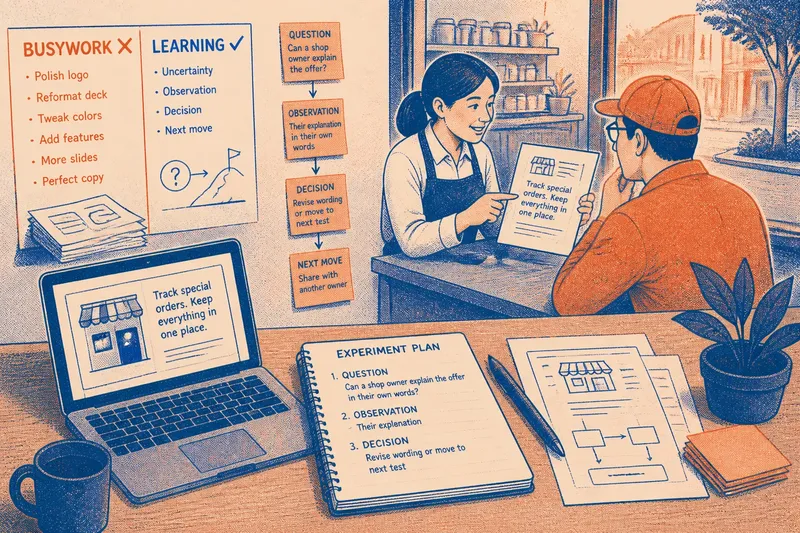
Use an interview when you need context around a choice. For example, if you are exploring how independent shop owners select packaging, you might ask what they considered the last time they ordered supplies, what trade-offs shaped the decision, and who else had input. Ask about a particular event rather than inviting a broad prediction about what they might do someday.
Conversations are also useful when the relevant behavior happens privately or infrequently. You may not be present when a customer compares insurance documents, arranges a home service, or decides whether to renew a subscription. A careful account can surface details that would otherwise be hard to witness.
But an interview records what someone remembers and chooses to say. A person may forget a small obstacle, describe a habitual action as deliberate, or give an answer that sounds reasonable in conversation. Treat what they say as evidence about their perspective, not a complete recording of their behavior.
What does observation reveal about a customer’s behavior?
Observation shows how a person approaches a task in a particular setting. You can notice where they begin, what they look at, what they ignore, when they pause, and what they do when the expected route is unclear. Those details are useful when the question concerns actions rather than explanations.
For instance, watching someone locate an item in a crowded online catalog may reveal that they scan category labels before using search, or that a filter is hard to notice. Asking what they would do is less direct evidence of how they respond to the actual page. Observation makes the interaction available for discussion while its details are still visible.
Keep the task natural and bounded. Ask the person to carry out something they already need to do, or to work through a clearly described scenario using the materials they normally use. Avoid steering them toward a feature or action you expect to see. If you intervene, note what you prompted so you do not mistake your suggestion for an independent choice.
Observation has limits too. A visible action does not explain its motive, and one setting may not represent another. If a customer skips a step, you can record that they skipped it; you cannot conclude from that alone that they do not value the step. Ask a neutral follow-up afterward if the reason matters.
How do I decide which method fits my question?
Write the question in plain language, then identify what kind of answer would resolve it. If you need to know why people choose, avoid, trust, or prioritize something, begin with a conversation. If you need to know where they look, what they try, or where they get stuck, begin with observation.
- Choose an interview to explore motives, preferences, decision criteria, or an event that you cannot watch directly.
- Choose observation to examine sequences, workarounds, attention, confusion, or the use of a tool in context.
- Use both in sequence when you need to see an action and then understand the person’s interpretation of it.
- Reframe the question if it asks for a future prediction but you need evidence about a current problem. Ask about the last relevant occasion instead.
Say you are considering a service that helps neighborhood food vendors prepare a weekly ingredient order. Your unresolved question is whether vendors struggle to notice missing items in their current ordering routine. Imagine observing one vendor compare a handwritten list with a supplier’s catalog, then asking what they were checking at the moment they paused. You could see whether a detail was overlooked and hear the vendor’s explanation, while keeping the observed action separate from the later interpretation.
That combination is not always necessary. If the question is simply what makes vendors prefer one supplier, start with interviews about a recent order. If the concern is whether the supplier’s order form makes an item difficult to find, watch someone use the form. Choose the smaller method that can answer the question you have now.
How should I ask questions without leading the customer?
Ask about a specific experience and let the customer supply the meaning. “Tell me about the last time you had to replace a damaged item” invites a concrete account. “Would a faster replacement service help?” puts a proposed benefit into the conversation and encourages a yes-or-no response.
Useful prompts include:
- “What were you trying to get done?”
- “What did you do next?”
- “What made that option seem like the right one?”
- “Was there anything you expected to happen that did not?”
- “What would you normally do at this point?”
Give the person time to answer. Do not fill every pause with a new question, and avoid praising a response that matches your hopes. If an answer is vague, ask for an example or a detail from the last occasion rather than offering possible explanations for them to choose.
For observation, state the task without describing the route you expect. Then watch quietly and record what happens in order. If the person asks for help, respond in a consistent, neutral way and note the point at which you stepped in. The aim is to learn from their approach, not to see whether they can guess your intended design.
How can I keep notes useful and respectful?
Capture what happened before adding your interpretation. In a notebook or a simple document, separate an observation such as “opened the paper invoice, then searched the email for a delivery date” from an interpretation such as “may expect the date to be in email.” The distinction makes it easier to see what you know and what remains a question.
For an interview, write down the situation, the person’s actions as they recall them, their stated reasons, and any uncertainty in the account. For observation, note the task, setting, sequence, interruptions, and any prompts you gave. Use a few short phrases during the session and expand them afterward while the details are fresh.
Explain why you are speaking with or watching the person, what you will record, and how the notes will be used. Ask permission before recording audio, video, or identifiable details, and avoid collecting information that is not needed for the question. If the setting or task is sensitive, choose a less intrusive way to learn or seek appropriate guidance.
What should I do when customers say one thing and do another?
Keep both pieces of information instead of treating them as a contest. The difference may reflect a forgotten detail, a change in circumstances, an answer shaped by the question, or a gap between what someone intends and what the task makes easy. Record the statement and the observed action separately, then look for a question that could clarify the difference.
For example, a person may say they compare delivery options carefully, while observation shows them choosing the first available option on a particular visit. That does not establish that they never compare. Ask what was different about this occasion, and consider whether the observed setting left out a constraint that matters in their usual routine.
A useful follow-up stays curious rather than accusatory: “I noticed you chose the first option on this screen. What was going through your mind then?” The person can explain their choice, and you can check whether the screen, the situation, or a time constraint shaped the action. Avoid correcting their account or suggesting that one source of information must be the true one.
How many people should I speak with or observe?
There is no universal number that makes a small customer inquiry conclusive. For an early venture decision, start with a manageable set of people who have direct experience with the task, and keep the claim narrow. A few focused sessions can reveal questions worth investigating; they cannot establish that every customer behaves the same way.
Recruit people who can speak to the situation you are studying, not only friends who are easy to reach. If your question concerns new customers, include people who recently faced the decision rather than relying solely on longtime customers. If the task varies by setting, include relevant settings or make clear which one you observed.
Pause to review the notes after each conversation or observation. Ask whether a new detail changed your understanding, whether the same part of the task remains unclear, and what evidence would help you decide next. If the central question is still open, adjust the prompt or observe a different relevant context instead of repeating an unchanged session.
Can I combine interviews and observation in one session?
Yes, if each part answers a distinct question and the conversation does not distort the behavior you want to see. A practical order is to ask briefly about the person’s recent experience, observe a natural task, and then ask about specific moments you noticed. Keep the first questions open so the person has not been coached into a particular explanation.
During the task, avoid asking the person to explain every move in real time unless speaking aloud is already natural to the activity. Constant prompts can change where they look and what they try. Instead, record points of uncertainty and ask about them once the task is over.
Use the combined approach when the action is visible but its meaning is not. If a café owner changes a recurring order, observation may show when the change happens; a later conversation may reveal whether it followed a sales pattern, a supplier issue, or a personal preference. Keep each explanation tied to the person and occasion rather than turning it into a rule for all customers.
What should I do with what I learn?
Turn notes into a small, testable next decision, not a sweeping claim about a whole market. State the observed behavior or reported reason, the context in which it occurred, and what remains unknown. Then decide whether you need another conversation, a different observation, or a modest change to the offer or process.
For example, if several people describe difficulty finding a delivery date and you have also watched someone search in the wrong place, you might make that date more visible in a draft form and observe how a relevant customer responds. Treat the response as a fresh piece of evidence about that draft, not as proof that the problem is solved everywhere. Keep the original notes so later decisions do not depend on a compressed memory of the session.
When choosing between customer interviews and observation, return to the distinction between reasons and behavior. Interviews help explain how customers understand a decision; observation shows how they approach a task in context. If both questions matter, pair the methods carefully, preserve the difference between what you saw and what someone said, and let the next customer question emerge from the gap.