The Busywork Myth: More Activity Does Not Mean More Progress
Spot startup busywork and redirect your time toward a small experiment with a clear question, an observable result, and a decision you can make.
You have spent the afternoon polishing a logo, sorting notes, and revising a spreadsheet, but still cannot say whether anyone wants the offer. To spot startup busywork, ask whether each task can change a decision about the venture, or merely leave behind a finished file.
A useful task has a question, an observable result, and a possible next move. If one of those is missing, pause before giving it more time.
Why can a full task list leave the venture unclear?
A task list tracks activity, not learning. Founders can finish many small jobs while avoiding an unresolved choice, such as which audience to serve, what offer to make, or what to build next.
Visible work is easier to schedule than uncertain work. Formatting a pitch deck has clear edges; deciding whether the offer is understandable can feel less comfortable. The deck may matter later, but it cannot answer that question by itself.
Rewrite a vague task as a decision. Instead of “finish the landing page,” try “learn whether a shop owner understands the offer from a short description.” The page only needs enough polish to support that test.
How can you tell when preparation has become avoidance?
Preparation can become a refuge from uncertainty. A founder may keep changing slides, names, or product details because those changes are controllable, while the result of a small experiment is not.
Set a stopping rule before polishing begins. For a one-page description, that might mean it names the intended customer, the problem, and the proposed change in plain language. Once those points are readable, use the page for its intended purpose instead of adding decoration.
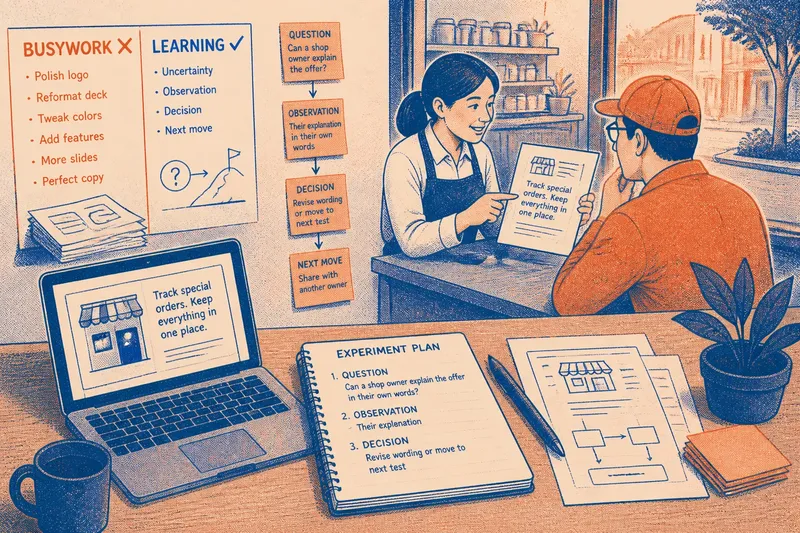
Imagine you are considering a service that helps neighborhood shops track special orders. You have revised its description several times but have not shown it to anyone. You decide the next question is whether a shop owner can explain the offer in their own words, share the current one-page version with one owner, and ask for that explanation; if the owner describes a different service, revise the wording, while a clear explanation means the description is ready for a next test.
How do you keep an experiment from becoming busywork?
Start with one uncertainty and choose an activity that can address it. Building a complex prototype, recruiting a broad audience, or tracking every reaction can make a small question harder to answer.
Write down three things before starting: the question, the observation that matters, and the decision it could inform. For example, if the question is whether a group understands a proposed service, show a short description and ask the reader to explain what they think it offers. If the explanation misses the offer, revise the wording; if it matches, move on to a different uncertainty.
Interpret each result narrowly. A compliment, a social media reaction, or a request for more information does not by itself establish purchase intent. Treat it as evidence only for the question the activity was designed to address.
What should you do when every task feels urgent?
Urgency often favors whoever is waiting for a reply, not necessarily the work that can clarify a venture decision. A customer email, a bookkeeping obligation, and a new feature idea may each require different treatment.
Separate required operations from exploratory work. Handle a real deadline; for the rest, identify the unresolved question that is blocking a choice and select the smallest task that could clarify it. Put worthwhile but unrelated ideas on a “later” list.
Say you are exploring a meal-planning service and feel pulled toward designing an app, posting on social media, and testing a paper meal-planning screen. Your unresolved question is whether the proposed screen makes a weekly plan easier to understand. Use the paper version with one person who fits your intended audience and ask them to complete a sample planning task; if they cannot identify the next action, revise the screen, while a clear next action lets you consider what other uncertainty to test.
What should you check before spending time on a task?
Use these checks when you are deciding whether an activity counts as progress toward a venture decision. Each result points to a concrete alternative if the task is not ready.
- Question: Can you state the uncertainty in one sentence? If yes, keep it visible while working; if no, write the decision you are trying to make and turn it into a question first.
- Audience: Does the person or material involved relate to that question? If yes, proceed with the planned activity; if no, identify a more relevant participant or source before spending time.
- Observation: Can you name what you will notice or record? If yes, prepare a note or simple form for that observation; if no, narrow the activity until a specific response or action is visible.
- Decision: Can the result change what you do next? If yes, write down the possible choices; if no, move the task to the later list or choose an activity tied to a pending decision.
- Scope: Can a simpler version answer the same question? If yes, use the simpler version; if no, keep the necessary parts and remove extras unrelated to the question.
- Timing: Does the task have a real deadline or operational consequence? If yes, handle it in time to meet that obligation; if no, compare it with the venture question currently blocking a decision.
These checks are not a scorecard for every hour. Some work keeps a venture functioning, while experiments are for reducing uncertainty. Use the checks when you are tempted to call an activity progress without being able to name what it will clarify.
Which experiment fits the question you need to answer?
How can I tell whether someone understands the offer?
Show a short description and ask the reader to explain what they think it offers and who it is for. If their explanation differs from the intended offer, revise the wording; if it matches, test a different question rather than polishing the same description further.
How can I learn whether a process is workable?
Use a paper sketch or simple mockup to walk through one realistic task. If the person cannot identify the next action, revise that part of the process; if they can, note what remains uncertain before adding features.
How can I distinguish interest from a meaningful next action?
Choose an observable action suited to the question, such as asking someone to review a draft or complete a clearly described follow-up. If they take the action, record only that they completed it; if they decline, find out whether the request was unclear or unsuitable before drawing a broader conclusion.
What should I do when the result is unclear?
Check whether the activity actually exposed the question you meant to examine. If the observation was vague, simplify the next activity and define what you will record; if the observation was clear but does not support a decision, revise the question.
How should you turn an experiment into a decision?
Close the loop while the details are fresh. Record what happened, what remains uncertain, and what choice follows, keeping the observation separate from your interpretation.
For example, if a reader describes a service differently from what you intended, record their explanation before noting your interpretation that the description may be unclear. Then decide whether to revise the wording or test it with another relevant person; do not turn one response into a claim about everyone.
Startup busywork gives way to useful progress when the next task answers a defined question. To spot startup busywork next time, write the question and decision beside the task; if you cannot connect them, choose a smaller activity or set that task aside.